he difference between gold and silver at the Olympic swimming competition often comes down to a single breath—or the absence of one. In the 2008 Beijing final of the men’s 100-meter butterfly, Michael Phelps won by 0.01 seconds, a margin so thin that officials needed slow-motion replay to confirm the touch. That race wasn’t about raw speed;it was about conserving a fraction of a stroke, timing an exhale, and trusting years of repetitive training. Olympic swimming competition is rarely decided by who swims the fastest lap;
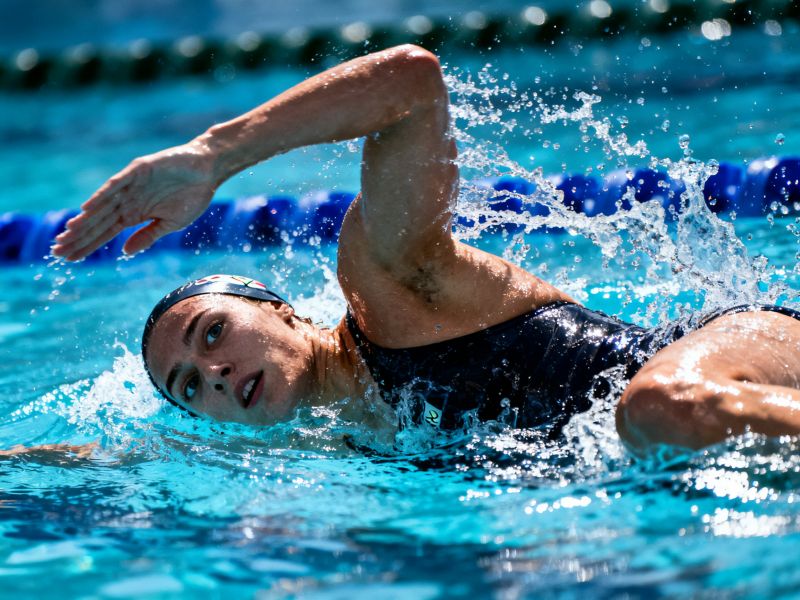
it’s decided by who manages the chaos of water, nerves。and lactic acid with the least wasted motion.Training for the Olympic swimming competition is a masterclass in controlled suffering. Take Katie Ledecky’s weekly routine in the lead-up to the Tokyo Games: roughly 60,000 meters of pool work, plus dryland sessions that include strength training and mobility drills. Her coach, Greg Meehan。has said that the hardest part isn’t the distance—it’s maintaining stroke efficiency when the body screams to slow down. Swimmers spend hours on “hypoxic sets” holding their breath for longer-than-race distances, to simulate the oxygen debt of a final. That kind of work isn’t glamorous. It’s repetitive, boring, and often painful. But it’s what separates a finalist from a semifinalist. I’ve watched local club swimmers try similar sets;most quit halfway through the first repeat. The Olympic swimming competition exposes that gap between ambition and tolerance.Technique in the Olympic swimming competition has evolved into a science of drag reduction. Underwater dolphin kicks—often 12 to 15 meters off each wall—now account for up to 30 percent of race time in short-course events. Caeleb Dressel’s underwater work in the 50-meter freestyle is a case in point: his breakout is so explosive that opponents often don’t see him until the 25-meter mark. Coaches use high-speed cameras and force sensors to measure hand pitch。elbow angle, and kick amplitude. A few degrees of wrist rotation can mean the difference between a clean catch and a slipping pull. That level of detail feels obsessive until you realize that at the Olympic swimming competition, a 0.5 percent improvement in efficiency can move a swimmer from eighth to fourth. I once spoke with a college coach who said, “We don’t train harder than everyone else anymore. We train smarter about the water”Pressure at the Olympic swimming competition is a beast of its own. The 2016 Rio final of the women’s 400-meter freestyle saw Katie Ledecky destroy the field by nearly five seconds—yet she later admitted that the night before, she barely slept. Nerves don’t disappear with talent. They get channeled. Swimmers develop pre-race rituals: the exact same warm-up, the same playlist, the same spot on the starting block. Simone Manuel。
after winning the 100-meter freestyle in Rio, described writing “Trust” on her hand as a reminder to stop overthinking. That’s the hidden skill of the Olympic swimming competition—managing the 30 seconds before the start。when your heart rate spikes and your legs feel like concrete. I’ve seen promising swimmers crumble at national trials simply because they couldn’t quiet their minds. The Olympics magnify that vulnerability a hundredfold.What makes the Olympic swimming competition compelling isn’t the medal count—it’s the visible struggle against physics and self-doubt. You can watch a swimmer like Adam Peaty。who dominated breaststroke for nearly a decade, and still see the strain in his face as he touches the wall. There’s no hiding in the water. Every inefficiency, every hesitation, is exposed in a 25-second sprint. That’s why the sport rewards a strange blend of patience and aggression: patience to drill the same turn ten thousand times, aggression to attack the first 15 meters of a race. The Olympic swimming competition will never be a casual watch for me—it’s a reminder that excellence is built in the quiet, unglamorous hours when no one is timing you.